Flat Feet in Children: What Parents Need to Know
- Cyndi

- 5 days ago
- 12 min read
If your baby’s or toddler’s feet look flat when they stand, you may wonder whether their arches are developing normally or whether the ankles are rolling inward too much.
Flat-looking feet are extremely common in babies and young children. In many cases, they are a normal part of development and do not cause pain or interfere with movement. However, not every flat foot looks or functions the same. The amount of pronation, the flexibility of the foot, your child’s age, and, most importantly, how your child moves and feels all matter.
The Quick Answer
|
What Are Flat Feet?
A child has flat feet when the arch along the inside of the foot appears low or absent while standing. You may also hear this described as pes planus, flexible flatfoot, or planovalgus foot posture.
The foot is a three-dimensional structure, so flat feet involve more than arch height alone. When a child bears weight, you may notice:
The arch lowers or disappears
The ankle rolls inward
The heel tilts outward
More of the inside border of the foot touches the floor
The front of the foot turns outward
The knees angle inward during standing, squatting, or walking
Some inward rolling is called pronation. Pronation is not automatically a problem. It is a normal movement that helps the foot adapt to the ground and absorb force. The question is whether the amount of pronation is expected for your child’s age and whether it affects comfort, stability, or function.
Why Do Babies and Toddlers Have Flat-Looking Feet?
Babies are not born with adult-looking arches. Several features make young feet appear flatter:
A natural fat pad fills the space along the inside of the foot
The bones and joints are still developing
The ligaments are more flexible
The muscles that support and control the feet are still becoming stronger
Balance and neuromuscular control are immature
Young children often stand with their feet wide apart and turned outward
The arch gradually becomes more visible as the foot grows and the soft tissues, joints, muscles, and movement patterns mature. Many children do not have a clearly visible arch until age 5 or later, and some healthy children continue to have low arches into adolescence or adulthood.
Arch appearance alone does not determine whether a foot is healthy. A child can have low arches and still run, jump, climb, and participate without pain or difficulty.
What Does a Typical Early Standing Posture Look Like?
When babies first pull to stand, they are learning to control their entire body over a very small base of support. A wide, somewhat flat-footed stance gives them more stability.
A new stander may:
Place the feet farther apart than an adult would
Turn one or both feet slightly outward
Keep the hips and knees somewhat bent
Shift more weight onto one leg than the other
Grip the floor with the toes
Lean the belly or hips against furniture
Hold the arms up or out for balance
Frequently move between standing and squatting

New walkers also tend to take short, stiff steps with the legs spread apart. They may place the whole foot down at once instead of using an adult-like heel-to-toe pattern. Their feet may look flatter and their ankles may roll inward when they accept weight.
As balance and strength improve, the base of support usually narrows, the arms lower, the steps lengthen, and the walking pattern becomes smoother. It is more useful to watch how this pattern progresses over time than to judge the feet from one photograph or one moment of standing.
Pediatric PT Tip: Look at your child’s feet during movement, not only while they stand still. Notice what happens when they squat, rise onto their toes, climb, run, and walk on different surfaces.
What Do Pronated Feet Look Like?

Pronation describes a combination of movements that occurs as the foot accepts weight. From behind your child, you may see the heel angle outward while the ankle appears to drop inward. From the front or side, the arch may flatten and the toes may point outward.
Parents often describe pronated feet by saying:
“The ankles look like they are collapsing inward.”
“My child stands on the insides of their feet.”
“The arches disappear when my child stands.”
“The shoes lean inward or wear unevenly.”
“The feet turn out when my child walks.”
Mild-to-moderate pronation can be typical in young children. More pronounced pronation may make it harder for some children to create a stable base for the rest of the body. The feet influence what happens above them, so excessive or poorly controlled pronation may be accompanied by inward movement at the knees and hips as well as poor core muscle activation.
That does not mean every child whose ankles roll inward needs braces or inserts. Foot posture should be considered together with age, flexibility, strength, balance, pain, endurance, coordination, and participation.
Flexible Flat Feet Versus Rigid Flat Feet
The distinction between flexible and rigid flat feet is important.
Flexible Flat Feet
With flexible flat feet, the arch is low or absent while the child stands but becomes more visible when the foot is not bearing weight. You may see the arch reappear when your child:
Sits with the feet off the floor
Lies down
Stands on tiptoes
Lifts the big toe while keeping the foot on the floor
Flexible flat feet are common in children and are usually painless. The joints continue to move, and the foot can adapt to different positions and surfaces.
Rigid Flat Feet
With a rigid flat foot, the arch remains absent even when the child is sitting or rising onto the toes. The foot may appear stiff, have limited movement, or be painful.
Rigid flat feet are much less common and should be assessed by a medical provider. Painful or rigid feet can have causes that are different from typical developmental flexible flat feet.
Are Flat Feet Caused by Weak Muscles?
Not necessarily. Foot posture is influenced by many factors, including bone shape, joint alignment, ligament flexibility, muscle control, body proportions, age, and family traits.
The small muscles within the feet and the muscles surrounding the ankles help support and dynamically control the arch during movement. These muscles become stronger as children:
Stand and shift their weight
Squat down and return to standing
Cruise along furniture
Climb
Walk uphill and downhill
Move over grass, sand, mats, and other safe surfaces
Balance without support
Rise onto their toes
Run and jump
These experiences can improve foot strength, balance, and control. They do not guarantee that a child will develop a high visible arch, because arch shape is not determined by strength alone.
Can Flat Feet Affect Walking and Balance?
Many children with flexible flat feet walk, run, and play without any difficulty. In these cases, the appearance of the feet may be more noticeable than any functional effect.

For some children, significant pronation may reduce stability or make movement require more effort. You may notice that your child:
Falls more often than expected for their age
Tires quickly during walking or active play
Frequently asks to be carried
Avoids running, jumping, climbing, or playground activities
Has difficulty balancing on one foot
Walks with the feet turned outward
Develops foot, ankle, knee, or lower-leg discomfort
Has trouble keeping up with peers
Wears down the inside of the shoes quickly
Has difficulty finding shoes that fit comfortably
These signs do not prove that flat feet are the cause. They indicate that it may be helpful to look more closely at your child’s overall strength, alignment, coordination, endurance, and movement pattern.
Do Bare Feet Help Build Arches?
Barefoot play gives the toes and feet opportunities to move, grip, balance, and respond to the surface. When the environment is safe, children can benefit from spending some time barefoot while standing, cruising, and walking.
Barefoot practice is not a treatment that will reshape every flat foot, but it can provide valuable sensory feedback and allow the foot muscles to work without being restricted by a stiff or poorly fitting shoe.
Consider barefoot play on safe, varied surfaces such as:
Firm flooring
Foam play mats
Grass
Sand
Carpet
Gently uneven outdoor surfaces with close supervision
Check the area for sharp objects, hot surfaces, splinters, and other hazards. Children do not need to remain barefoot all the time. Practicing both barefoot and in well-fitting shoes helps them learn to adapt to different environments.
What Shoes Are Best for Children With Flat Feet?
Shoes should protect the feet and allow comfortable movement. A good everyday shoe generally has:
Enough width for the toes to spread
A secure heel so the foot does not slide excessively
A sole that bends near the ball of the foot
A level, stable base that does not have rounded sides
The correct length and width
A fastening system that holds the shoe on the foot
Avoid shoes that are excessively narrow, heavy, slippery, or curved from side to side in a way that makes it harder for a new walker to find a stable base. Very loose slip-on shoes may also require a child to grip with the toes to keep them on.
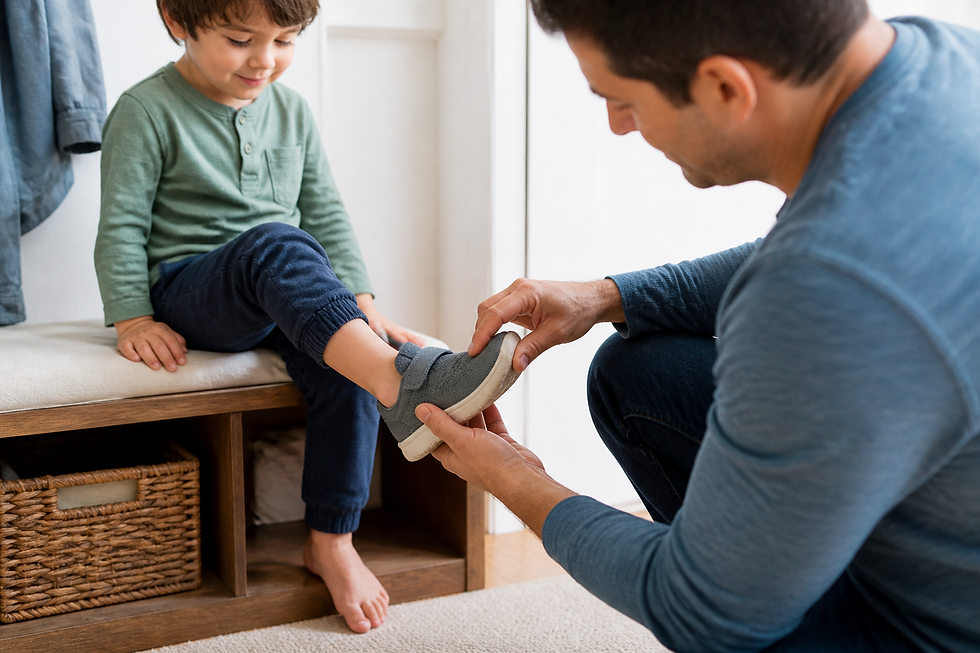
A more supportive shoe may improve stability for a child with significant pronation, but the most supportive shoe is not automatically the best shoe for every child. The right choice depends on how the child’s feet move and how the footwear affects walking, balance, and comfort.
Does My Child Need Orthotics?
Most children with painless, flexible flat feet do not need orthotics simply to create the appearance of an arch. Shoe inserts do not permanently build or reshape a typical flexible arch.
Orthotics may be considered when a child has symptoms or functional difficulties such as:
Foot or leg pain
Fatigue with walking
Significant instability
Develops an arch along the outside edge of their feet
Difficulty participating in age-appropriate activities
A foot position that contributes to an inefficient walking pattern
A specific medical, orthopedic, or neuromuscular condition
The goal of an orthotic is usually to improve comfort, alignment, stability, or participation, not to make every child’s footprint look the same.
When an insert is appropriate, an over-the-counter option may sometimes provide enough support. Other children may benefit from a more customized orthotic that extends slightly above the ankle bones. The decision should be based on an individualized examination rather than arch appearance alone.
Activities That Support Foot Strength and Balance
Children build foot and ankle control through active play. Depending on your child’s age and abilities, try:
Squatting During Play
Place toys on the floor and encourage your child to squat to pick them up before returning to standing. Squatting strengthens the hips, legs, ankles, and feet while challenging balance.
Reaching in Standing
Place toys slightly to each side so your child shifts weight from one foot to the other. Start with support from a couch or low table if needed.

Rising Onto the Toes
Place a favorite toy or sticker slightly above shoulder level. Reaching upward encourages the calf and foot muscles to work and may make the arch more visible.
Walking on Different Surfaces
Let your child walk over grass, carpet, firm flooring, playground surfaces, or a simple cushion path with close supervision. Each surface requires the feet and ankles to make small adjustments.

Climbing
Climbing onto safe cushions, up playground steps, or over low obstacles develops strength and coordination throughout the legs and feet.
Pushing and Pulling
Pushing a sturdy laundry basket or age-appropriate push toy can encourage weight shifting and active use of the feet. Make sure the object moves slowly enough for your child to remain in control.
Balance Games
Older toddlers and children can step over objects, walk along a taped line, kick a ball, stand with one foot on a low step, or briefly balance on one foot with help.
These activities support general strength and balance. They should be comfortable and matched to your child’s developmental level. Stop and seek guidance if an activity causes pain.
When It May Help to Talk With a Pediatric Physical Therapist
Consider asking for an evaluation if your child:
Has foot, ankle, knee, or leg pain
Has one foot that looks significantly different from the other
Has feet that appear stiff or do not develop an arch when sitting or rising onto the toes
Consistently walks on the inner borders of the feet
Has pronounced ankle collapse that affects standing or walking
Falls much more often than other children of a similar age
Tires quickly or frequently asks to be carried
Avoids walking, running, jumping, climbing, or active play
Has difficulty keeping up with peers
Develops blisters, calluses, or persistent areas of shoe pressure
Has a sudden change in foot posture or walking pattern
Has a known neurologic, muscular, genetic, or orthopedic condition
Is not making expected progress with standing or walking
Have developed an arch along the outside edge of their feet
A pediatric physical therapist can assess more than the height of the arch. The evaluation may include foot and ankle flexibility, leg alignment, muscle strength, balance, coordination, walking and running patterns, endurance, footwear, and participation in everyday activities.
Depending on the findings, recommendations may include play-based strengthening, balance activities, stretching, footwear changes, orthotics, or referral to another medical provider.
Key Takeaways
Flat-looking feet are common in babies and young children.
A visible arch may not develop until age 5 or later.
Pronation is a normal part of accepting weight; the amount and its effect on function matter.
Flexible flat feet develop an arch when the child is sitting, non-weight-bearing, or rising onto the toes.
Painless flexible flat feet usually do not require treatment.
Barefoot play and varied movement experiences support foot strength and balance but do not determine arch shape by themselves.
Shoes should fit well, allow toe movement, and provide a stable base.
Orthotics are generally used to address symptoms or functional difficulty - not simply to make the arch look higher.
Pain, stiffness, asymmetry, fatigue, frequent falls, or difficulty participating should be evaluated.
Frequently Asked Questions
Is it normal for my toddler to have flat feet?
Yes. Most toddlers have flat-looking feet because the arches are still developing, the joints and ligaments are flexible, and a fat pad fills the space where an adult arch is visible. What matters most is whether the feet are flexible, comfortable, and supporting age-appropriate movement.
At what age should my child develop arches?
Arch development happens gradually and varies from child to child. Many arches become more noticeable around age 5 or later. Some children and adults remain naturally flat-footed without pain or limitations.
How can I tell whether my child’s flat feet are flexible?
Look to see whether the arch appears when your child sits with the feet relaxed or rises onto the toes. If the arch reappears, the foot is likely flexible. This observation does not replace a professional examination, especially if your child has pain or movement difficulties.
Is pronation the same as flat feet?
The terms are related but not identical. Flat feet describe a low or absent arch. Pronation describes movement of the foot as it accepts weight. A pronated foot often looks flat, but pronation also includes changes at the heel, ankle, and front of the foot.
Will going barefoot fix flat feet?
Barefoot play can strengthen the feet, encourage balance, and provide useful sensory input. It does not guarantee that a visible arch will form or permanently change a child’s natural foot structure.
Can the wrong shoes cause flat feet?
Shoes do not usually cause a flexible flat foot, but shoes that are too narrow, unstable, stiff in the wrong places, or poorly fitted can make walking less comfortable or more difficult. Choose shoes based on fit, comfort, and how your child moves in them.
Do high-top shoes correct pronation?
High-top shoes may provide more support around the ankle, but they do not permanently correct pronation or create an arch. Some children move more steadily with additional support, while others do not need it. Footwear should be selected for the individual child.
Do orthotics build an arch?
Orthotics can support the foot and may improve pain, fatigue, alignment, or stability while they are being worn. They do not usually create a permanent arch in a child with typical flexible flat feet.
Should flat feet stop my child from running or playing sports?
No, not when your child is comfortable and participating successfully. Children with painless flexible flat feet can generally take part in regular play and sports. Pain, repeated injury, or difficulty keeping up deserves a closer look.
You Don’t Have to Figure This Out Alone
It can be difficult to know whether your child’s feet are simply following a typical developmental pattern or whether their posture is affecting balance, comfort, or mobility.
A pediatric physical therapist can help you understand what you are seeing and determine whether your child would benefit from specific activities, different footwear, or additional support.
Explore more parent-friendly developmental resources at Starting Point, or reach out for guidance tailored to your child.
Sources
American Academy of Orthopaedic Surgeons. Flexible Flatfoot in Children.
Banwell HA, Paris ME, Mackintosh S, Williams CM. Paediatric flexible flat foot: how are we measuring it and are we getting it right? A systematic review. Journal of Foot and Ankle Research. 2018.
Xu L, Gu H, Zhang Y, et al. Risk Factors of Flatfoot in Children: A Systematic Review and Meta-Analysis. International Journal of Environmental Research and Public Health. 2022.
This article is for general education only and is not a diagnosis or a substitute for individualized medical care.
About the Author
Cyndi Stedman, PT, DPT is a pediatric physical therapist with over 17 years of experience supporting infants and toddlers. Through Early Intervention and home-based therapy, she has helped more than 1,000 families support their child’s development. Her goal is to give parents clear, practical guidance so they feel confident helping their child learn to move and grow.

Comments